Rachel Cohen-Lunning and Merrilee Litchenstein Cohen, sisters and co-owners of Mercura Sunglasses (pronounced mer-cur-ay), have been designing jewelry and glasses since the 1970s. Recently, I was able to sit down (or rather stand, as I observed the myriad of sunglasses sprinkled across their table, a couch, and on various desks in Merrilee’s midtown home) and talk with them in two interviews about their past, their future, and what it means to be an artist.
Merrilee met me outside their home in the heart of midtown. We rode an old elevator up to her apartment, where I was greeted by her miniature pooch, Sophie, and Merrilee’s photographer husband. I was taken into a room, possibly a former dining room, now a haven for their jewelry and sunglasses, and was greeted by Desiree Venn Frederic, a former model turned stylist. She was currently working on a project and needed to borrow some glasses for a photo shoot. I stood in the doorway in awe, touching each piece (sunglasses and jewelry) carefully as to not break or harm them, and daring to try on only a few in fear of stretching the glasses. Some of the pieces were from the 1970s and 80s, one of them was worn by Gaga (in the first scene of Telephone), another by Cher, others by Drew Barrymore, Madonna, Paula Abdul, and Ivona Trump, just to name a few.
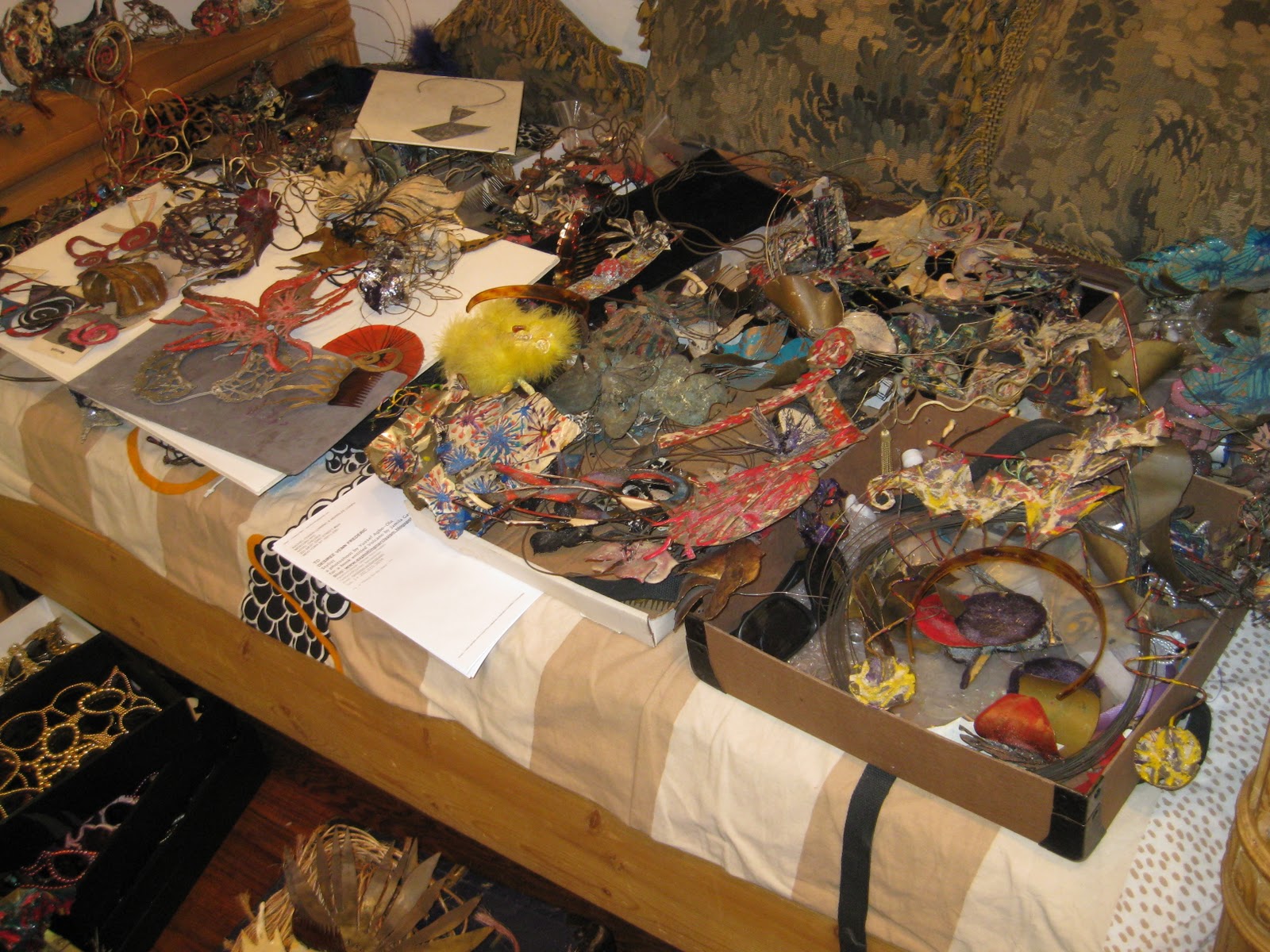
There were sunglasses everywhere--in every nook and cranny of the room, in the walls, in chests, and in desks. Somehow each piece was able to maintain its prestige, even as some were almost 40 years old. The sisters began designing metal body sculptures, art, and eye jewelry at the Chelsea Hotel (where I interviewed them a second time) in the 1970s. Making art, especially sunglasses, is one of their loves in life. “We’re always thinking of ways people can look better,” the sisters told me.
 |
| A pair of Mercura NYC sunglasses. |
 |
| A magazine cover the sisters were on (bottom left and top right) | | | |
As I pointed to each pair of glasses, Merrilee and her sister, who had just arrived, described in full detail who wore each one, what magazine cover they were on, and what they were made out of. They were so humble in speech I almost had to remind myself that I was talking to the most influential sunglass makers in America (according to Eyeglass Retrospective). Their glasses have been on the covers of countless magazines, in even more editorials, and on the most famous celebrities. I’m sure I pinched myself a few times.
As we were sifting through the dozens of glasses, I mentioned to the sisters that their chain linked glasses were the rave in Connecticut. They were surprised to know that stores and independent manufacturers everywhere carried copies of the original. “Oh, yeah,” I told them, “Everyone wears them. Sometimes even downtown, I’ll see the glasses being sold on street corners.” Mercura invented those glasses in the 1980’s. It’s shocking what trends will come back into style years later.
 |
| Boxes full of their jewelry and sunglasses. |
|
After about an hour and half of eyeglass sorting and jewelry spotting, the sisters showed me book after book of magazine covers that sported their glasses, editorials, and anything else that deserved to be laminated. “People who are used to looking good know what to buy,” the sisters said, “If you want to look good, you’ll wear our glasses.”
It’s no doubt people want to look good. Steven Meisel photographed eleven pairs of Mercura glasses for Italian Vogue this year, and a few years ago photographed Christy Turlington with a cigarette holder the sisters made. Their glasses have been used in numerous runway shows, such as Boudoir D’huitres, Zoe Twitt, and Indashio. “Before Vera Wang designed her own glasses, she used ours,” said Merrilee. Michael Musto (I could die) wore them in a show, as well as Amber Rose and Christina Milian. “It never ceases to amaze us..the two extremes of people who wear our glasses; people who never dress up and those who always do,” she continues, “I would love to see our glasses on Michelle Obama.” (So would I, can you imagine?!)
 |
| A cigarette holder made by the sisters. |
|
I can go on for ages about who has worn Mercura, but I’ve learned that it’s not who wears the glasses, rather how they wear them. Each piece is a reflection of individual style, and when I ordered mine (see image below), I wanted to pair it with an opaque leopard dress from H&M, thick wooden heels, and a blue or red purse. I might possibly throw in a faux leather jacket (I’m a veggie!)...we’ll see! Either way, I know people will be looking, and I will be looking fabulous.
 |
| Some of their pieces. |
The sisters are proud of their work, and they should be. They have articles in the New York Times, and they were all over Italian Vogue in the 1990’s. “You have to be in a magazine to sell anything,” the sisters give me some advice. Their inspiration for their pieces, they tell me, comes from their mother, who was an artist and painter. Their childhood was centered around art, so it’s no surprise that they intend to pass the tradition down to their children. “Making sunglasses is one of our loves in life,” Rachel claims.
 |
| Merrilee and myself. I am wearing the glasses I bought, and Merrilee is wearing a different version. |
 |
In detail: beautiful hand crafted brass compliments fall fashion
very well with hints of Victorian vines and.flowers |
I sat down with the sisters in the lobby. Merrilee took out the pair of glasses I was going to purchase, along with others to talk about them. A group of fashionably clad ladies with their pooches happened to spot us in the middle of the room and made their way over to admire the pieces. I learned that there is a different process for making each piece. They work with different materials and get their frames from all over the world; some they’ve had since the 1970’s. They would rather use conventional materials in unconventional ways rather than just unconventional materials. Some of the pieces are made from macaroni, paper mache, lacquered board, brass, and seashells. “We would love to make something untouched by anyone,” they chime in.
As the girls with the pooches began to leave, Merrilee told me that her and Rachel would only go to parties when they were promoting their glasses or jewelry. “It takes a consuming amount of energy to make things. It’s a 24/7 process,” says Rachel. They never left their rooms in the 70s, and they weren’t social at all. They were on the opposite end of the scene, as Merrilee put it. I began to think they were introverted, as most artists are, being true to only their art.
 |
| Desirée Venn Frederic modeling one of their designs. |
“A lot of people had the same introverted vibe. They wanted to have a certain degree of sincerity when they started,” the sisters told me. To be sincere is to have respect for your art, for your talent, and for other artists as well. “We did mirror art in the 1970s..some paintings have streams of glue! It feels wonderful doing what we love to do,” they continued, “anything we make can be glorified as a building, windows, or freestanding works of art,” she referred to the design aesthetic of the glasses. “Everything is done differently. Some things are more elaborate than simple. We’ve met some really inspiring people in the fashion industry. The people in the industry love art and want to keep it as an art form that needs to be extended to more art. That’s how we think; everything can be extended.”
 The sisters are big appreciators of art, admiring the likes of Antonio Gaudi and Frank Gehry (the lead architect for the Guggenheim Museum in Spain). “We love people who are avant garde and fearless,” says Merrilee. The sisters broke all rules of contemporary art because they wanted to reach out to something new. They wanted to be connected with something else--to bond the futuristic with ancient so everything had humane and at the same time unusual energy.
 |
| Scattered on a table: Works of art. |
“People perceived everything we did as unconventional. That’s not true for a lot of designers. We tend to go forward and reach back. It’s like going back in time. We are reaching into our memories and pulling them forward. It resolves feelings. Sunglasses are private, they are walls of privacy. People see you though a control blank, and you can portray yourself as anything. Kings and Queens would love our glasses,” they continued.
As for their future, Merrilee says they would love to expand, however not in terms of mass manufacturing. They wouldn’t want their glasses to be remade or copied unless they were the ones doing so. “It’s like a print version of an artist’s painting,” says Merrilee. She’s right--you can print thousands of paintings, but there will always be just one original. They instead would like to expand aesthetically and most probably emotionally with their glasses.
The sisters don’t consider themselves as businesswomen. “In the field of art, I would advise any artist to keep flowing with things that make them feel good. You will achieve good experiences doing so, and that is what life is about,” they tell me, “You have to be serious in order for your product to be valuable. Society is prolific. We make as artist but couldn’t do it without seriousness. Being playful is a very serious situation. We were always seriously interested in what would make people look better.”
I was curious to know what Merrilee thought the definition of an artist was. “An artist is an inventor. Art is inventing and sensitivity. Van Gogh made new tools to expand himself. An artist is unafraid to make new tools to express himself,” she explained to me. I was hanging on to every spoken word at that point. I glanced around the room, and there was a guy walking toward us. He stopped right before Merrilee and said, very matter-of-factly, that their glasses reminded him of oil paintings. He happened to be a photographer (that I featured on my blog a few weeks ago). He left and we moved on to some trivia questions that I had for Merrilee and Rachel.
If you could be anywhere in the world, where would you be? “On top of a mountain in Alaska.”
What is the one food you won’t eat? “Artificially flavored and artificial foods.”
How many children do you guys have? “I have one girl, who is 11, and Rachel has one boy, who is 14.”
What legacy would you like to leave behind? “That nothing comes from nothing. We’ve worked so hard to be so lucky.”
I left the hotel (with all of its energy) with new hope for the fashion industry. I have always considered fashion art, but hearing it from an artist reassured me. It’s comforting to know that everyone has a little bit of an artist inside of them to comprehend words and figures, to see, to create, and to innovate.
If you wish to contact Mercura NYC, you can do so at this email address: mercurany@aol.com

 While the work was often daunting, Bakel proved himself a sought after designer quickly. Four years into his stint at Hilfiger, he was recruited by Gap as an outerwear designer and soon was at the helm of Old Navy’s denim line. Inspiration on a trip to Mexico gave him an idea on where to take denim. Coming home invigorated and full of ideas he put his concepts to work. Where Old Navy had previously had upwards of seventy washes for their denim, Bakel narrowed that down to four focusing on the quality of the workmanship in the hardware and design and bringing the most popular washes to the forefront. To keep the price point low as Old Navy is famous for, they bought an enormous amount of denim, keeping the denim mills overseas in business and making such large purchases that they were able to be the mill’s only client for a year at a time. The mills he worked with there were based in both the US and Japan. This relationship produced a superior product and was a massive success for Old Navy.